
Openlayer
Open siteIntroduction
Openlayer is a platform for designing and evaluating machine learning models.




Openlayer Product Information
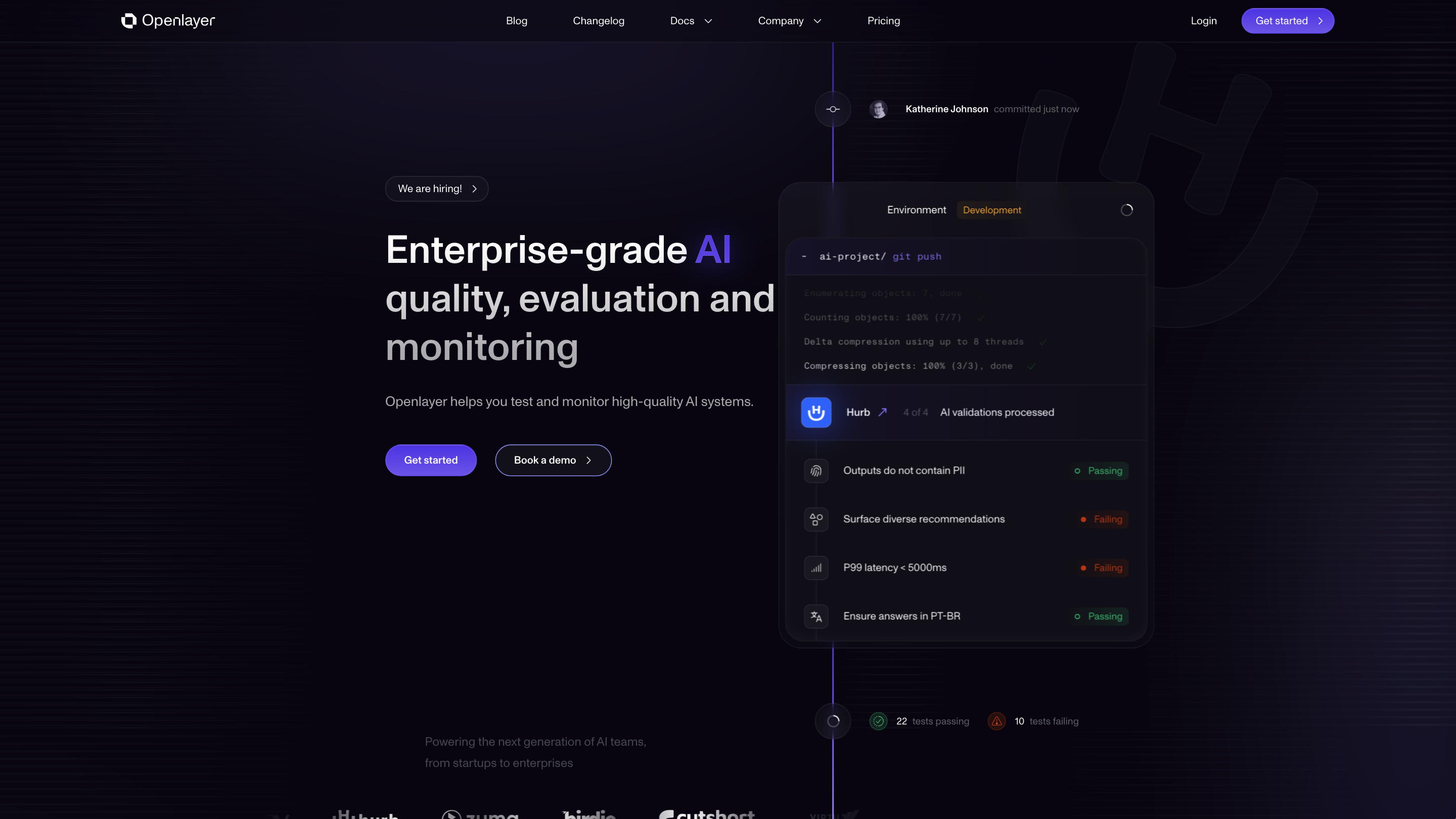
Openlayer — Enterprise-grade AI quality, evaluation and monitoring is a platform designed to help organizations test, evaluate, and monitor AI systems in production. It provides end-to-end tooling to observe real-time requests, run robust tests, manage experiments, and integrate AI workflows into existing development pipelines. Openlayer supports project templates, templates for common AI patterns, REST/CLI/SDK access, and seamless integration with popular Git and CI/CD workflows. The platform emphasizes reliability, observability, and collaboration across teams from startups to enterprises.
How to Use Openlayer
- Get started: Create a project, connect your data sources and AI models, and choose a template or start from scratch.
- Set up monitoring: Enable real-time observability for requests, latencies, and outputs; annotate with human feedback for improvements.
- Run evaluations: Use built-in tests or customize tests to validate accuracy, latency, bias, safety, and other objectives across environments (Development/Production).
- Integrate and deploy: Use REST API, CLI, or SDKs to integrate into your existing tooling, deploy inference pipelines, and manage versions.
- Collaborate: Share results, assign roles, and review test outcomes with your team in a shared workspace.
Core Capabilities
- Real-time tracing and observability for all system requests
- Flexible evaluation framework with customizable tests
- Templates and sample projects for common AI patterns
- API reference, SDKs, and CLI for broad language support
- Git integrations and CI/CD-friendly workflows
- Production-ready monitoring and alerting
- Collaboration features for team-based validation and debugging
- Privacy-conscious and enterprise-grade security best practices
How It Works
- Create or clone a project, configure pipelines, and select or customize tests.
- Openlayer collects, traces, and analyzes live data from AI services, enabling rapid detection of issues and performance bottlenecks.
- Use templates to jumpstart common AI patterns (e.g., QA retrieval, RAG pipelines, structured outputs, classifiers) and iterate quickly.
- Integrate with your existing tools via REST, SDKs, and CLI to fit your workflow from prototype to production.
Safety and Best Practices
- Leverage real-time monitoring to catch regressions and bias; validate outputs against objective criteria.
- Use collaboration features to align stakeholders and ensure responsible AI practices across environments.
Core Features
- Real-time observability and tracing for all AI requests
- Built-in evaluation suite with customizable tests
- Project templates and AI pattern templates for rapid setup
- REST API, SDKs, and CLI for flexible integration
- Git and CI/CD integrations for seamless workflow
- Environment-specific monitoring (Development and Production)
- Collaborative workspace with roles and test sharing
- Privacy-conscious, enterprise-ready security and governance
Templates and Projects
Openlayer offers templates for common AI patterns and the ability to create and manage multiple projects, experiments, and inference pipelines. Templates help teams accelerate setup and ensure consistent evaluation practices across initiatives.
Observability and Testing Details
- Track latency, throughput, and correctness with objective-driven tests
- Annotate requests with human feedback to improve models over time
- Run tests on live data to ensure robustness and reliability
Integrations and Ecosystem
Openlayer provides integrations with popular tools, SDKs in multiple languages, and out-of-the-box support for major LLM providers. It is designed to fit into diverse workflows, from prototyping to large-scale production deployments.